.png)
Exploring the Fusion of Artificial Intelligence and IoT to Unleash the Power of Synergy

Updated: Jul 10, 2024
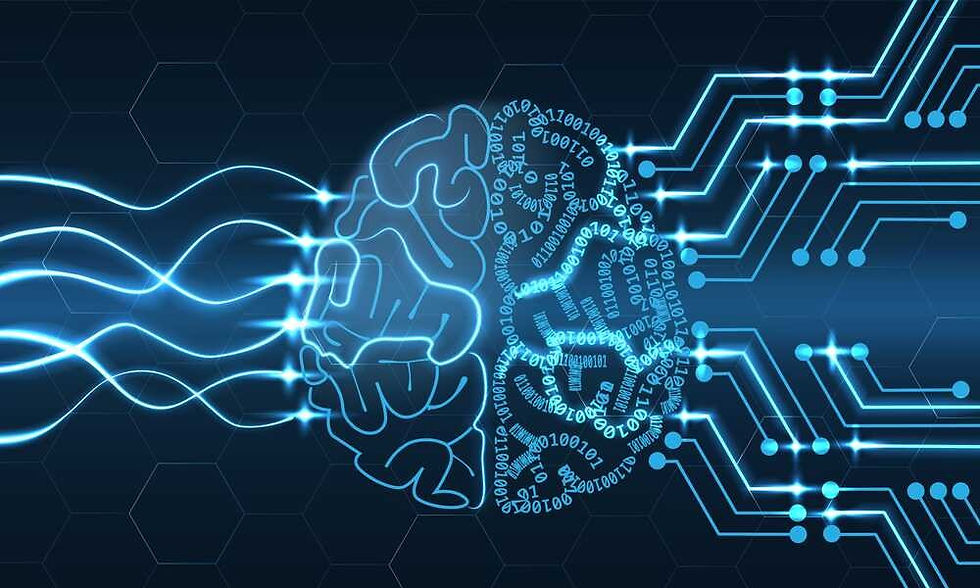
The combination of artificial intelligence (AI) and the Internet of Things (IoT) is a powerful partnership that is transforming processes and reshaping industries in today's fast-paced technological landscape. The combination of AI's analytical skills and IoT's capacity to generate data creates a synergistic force. When combined, they create a dynamic ecosystem in which gadgets interpret, learn, and behave intelligently in addition to gathering data.
The Interaction of AI and IoT:
Converging Intelligence: IoT is essentially about connecting devices to the internet to gather and share data. The vast amount of data produced by this network of linked devices can be too much for conventional analytics systems to handle. This is where artificial intelligence (AI) comes in, offering the analytical skills required to make sense of massive amounts of data. We build an ecosystem where devices gather data, analyze it, learn from it, and react intelligently by fusing AI and IoT.
Real-Time Insights: AI algorithms, in particular machine learning models, can process data instantaneously, providing IoT systems with instantaneous access to actionable insights. In situations where quick decisions are needed, like in industrial settings where equipment failures require immediate attention, real-time processing is essential. The interplay guarantees that Internet of Things (IoT) devices are not only data gatherers but also sentient entities with the ability to make deft decisions at any time.
Enhanced Automation: Automation, which enables devices to carry out tasks without human intervention, is synonymous with the Internet of Things. That being said, AI integration improves automation. In response to changing conditions and data trends, AI algorithms can optimize and modify processes. Because of their flexibility, Internet of Things systems are guaranteed to grow more effective over time as they continuously learn and perform better.
How AI Improves IoT System Decision-Making:
Analytics that predict: Predictive analytics represents one of AI's most important contributions to the Internet of Things. To predict future events, machine learning algorithms examine historical data to find patterns and trends. For example, AI-powered predictive maintenance in industrial applications can predict equipment failures ahead of time, enabling proactive maintenance and cutting downtime.
Making Context-Aware Decisions: IoT systems gain context awareness thanks to AI. AI systems can produce more complex and knowledgeable decisions when they comprehend the environment in which the data is produced. AI, for instance, can evaluate user behavior, meteorological data, and energy costs in a smart home to optimize the operation of heating and cooling systems, guaranteeing comfort while consuming the least amount of energy.
Learning that Adapts: AI's capacity to learn from data is revolutionary for Internet of Things systems. AI can adapt to ever-changing environments and changing patterns through continuous learning. In dynamic scenarios like traffic management in smart cities, this flexibility is essential. Artificial intelligence algorithms can learn from real-time traffic data and modify traffic light timings to maximize vehicle flow and minimize congestion.
Safety and Indicator Identification: When it comes to IoT deployments, security is the main concern. By identifying irregularities and possible threats, artificial intelligence (AI) greatly improves the security of Internet of Things systems. To detect anomalous activity and alert users to possible security breaches before they get worse, machine learning models can examine patterns in network traffic and device behavior.
FAQs
Q: How does AI improve IoT system decision-making?
A: AI algorithms, in particular machine learning models, can autonomously derive actionable insights and make well-informed decisions by analyzing massive amounts of data collected in real-time by IoT devices. This improves productivity and makes it possible to react proactively to changing circumstances.
Q: What are the main advantages of combining IoT and AI?
A: Automation is improved, predictive analytics is made possible for proactive decision-making, context awareness is provided for nuanced responses, security is strengthened through anomaly detection, and adaptive learning is encouraged for continuous optimization. All of these benefits come from the integration of AI with IoT systems and ultimately lead to increased productivity and innovation in a variety of industries.
Q: What are a few AI-related IoT applications?
A: Adaptive learning in traffic management systems, context-aware decision-making in smart homes, predictive maintenance in industrial settings, and anomaly detection in IoT networks are just a few of the IoT applications that AI improves.


Comments