
CONNECTED TECHNOLOGY. CLEARLY EXPLAINED.
Soil-moisture informed irrigation: an advisory pilot
Plan a soil-moisture advisory pilot with representative zones, measurement references, crop/weather context, accountable irrigation decisions, offline fallback and field maintenance.
Advisory pilot design · By Admin · Reviewed 18 October 2026. No field installation, water saving or crop-yield outcome is reported.
Begin with one irrigation management zone and a question the grower needs to answer. Soil observations should help the responsible grower or agronomist review an irrigation decision alongside weather, crop and field context. The initial pilot records and advises; it does not switch a pump or valve automatically.
Define the zone and the decision owner
Represent the actual zone
Document the crop, soil differences, irrigation layout and observation locations with a competent adviser. One convenient sensor position is not evidence that an entire field has the same condition.
Know what the sensor reports
Volumetric water content and soil-water tension describe different measurements. Retain the sensor type, units, depth and applicable calibration/reference evidence. Do not copy a threshold from another soil, crop stage or instrument.
Keep irrigation authority clear
Name the person who reviews the observation and approves an action, including during an outage. The existing local irrigation procedure remains in service. A dashboard flag is not an instruction to energise equipment.
Follow the observation to an accountable decision
1 · Record the management zone
Use a stable zone and observation-point ID. Record crop stage, relevant soil profile, irrigation method, agreed sensor locations/depths and the responsible reviewer. Keep exact farm coordinates and private operating records out of an initial public enquiry.
2 · Install and establish a reference
Follow the actual manufacturer’s installation method with competent field support. Document soil contact, installation disturbance and the calibration/reference-check basis. Keep representative field observations with the initial record; do not treat a displayed number as proof of a correct installation.
3 · Preserve the observation path
Record sensor/logger identity, measurement time, units, power state and receipt time. Demonstrate the agreed local storage and later upload path. Missing or stale observations must remain visible rather than being filled with an assumed healthy condition.
4 · Add weather and application context
Associate rainfall, the irrigation event and available applied-water observations with the same zone and time window. Distinguish a planned irrigation from a confirmed application. Retain maintenance or sensor movement that could explain a changed trend.
5 · Review and approve the next step
The named grower or agronomist reviews the observation, crop/soil context and existing irrigation plan. Record whether they continued, adjusted, deferred or investigated, with their reason. Site-specific targets and water/application constraints must be agreed locally, not supplied as a universal value by this guide.
6 · Reconcile application and maintain
Record the actual approved action, measured application where available and a comparable follow-up observation. Log cable, battery, mounting or soil-contact checks and any reinstallation. A changed sensor, location or season may need a new reference before trends can be compared.
Keep pump control as a separate engineering decision
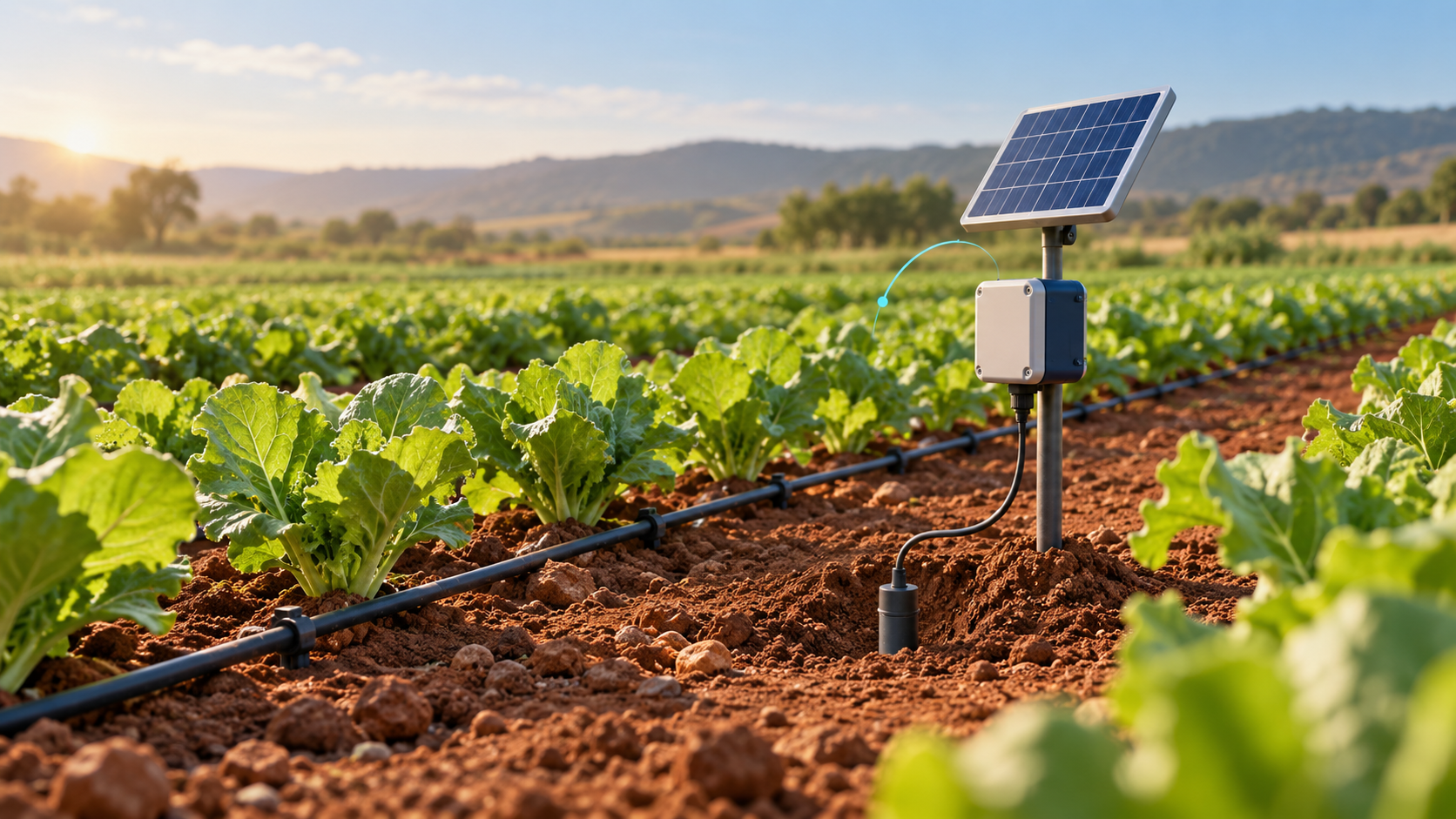
The advisory path is sensor → logger/transport → contextual record → responsible review → existing local irrigation procedure. Any later controller integration needs a verified interface, authority limits, local equipment protections, manual override and a tested recovery process agreed by the qualified installation owner. This proposed pilot supplies no automatic pump command or validated control logic.
Agree the offline procedure in advance
Name who notices stale data, how they obtain a local observation and who uses the farm’s existing irrigation procedure while telemetry is unavailable. Rehearse an approved communications/power interruption without risking the crop or equipment. Do not assume that always stopping or always continuing irrigation is a suitable universal fallback.
Measure the usefulness of the advice
Data coverage: valid expected readings by agreed zone/depth and monitoring window. Report gaps, late uploads and disturbed/replaced sensors separately.
Decision trace: observations reviewed with sufficient context, the elapsed review time and recorded reasons for the authorised action. Retain unresolved or contradictory observations.
Application evidence: measured applied water where an appropriate meter exists, with irrigated area, rainfall and crop/soil context. A shorter runtime alone does not establish a water-volume saving.
Work and outcome: field visits, maintenance effort, actual costs and crop observations over comparable conditions. No water-saving percentage, yield gain or ROI is claimed by this planning framework.
Plan the field-maintenance season
Assign installation and service owners before purchase. Include access around field operations, protected cables/power, identification of sensor locations, spare/replacement arrangements and the review after disturbance or reinstallation. Agree a maintenance schedule using the actual device instructions and field conditions.
Compare the full sensing route
A sensing/logger route and a managed agronomy service allocate different work to the owner. Confirm sensor/soil scope, power and coverage, advisory responsibilities, export, recurring charges and local support. A platform feature list does not establish that a control interface or agronomic service is included.
Prepare the requirements brief
Describe the zone, crop stage, soil variation, irrigation method, measurement need, existing local decision process, power/network constraints and service expectations. Prepare a private requirements enquiry for Admin review. An unlisted provider can be named in the non-confidential brief; onward sharing is optional.
Sources and applicability
The extension sources provide measurement and selection context. Their regional examples and older price tables are not current India quotations or local irrigation prescriptions. The six-step accountability workflow and KPI definitions here are an original proposed pilot. Apply any operating thresholds with competent advice for the actual crop, soil and irrigation system.
Soil moisture sensors for irrigation scheduling
Continue the agriculture research
PROVIDER OPTION
METER TEROS 12 and ZL6 — sensing route
Investigate the measurement/logger route and who will interpret the observations.
PROVIDER OPTION
CropX Apex and irrigation planning — advice route
Investigate sensing, telemetry and the proposed agronomic service.
INDUSTRY
Agriculture
Connect field observations, irrigation ownership and service decisions.
PRIVATE ENQUIRY
Prepare a private requirements enquiry
Describe the zone, decision process and evidence gap for Admin review.