
CONNECTED TECHNOLOGY. CLEARLY EXPLAINED.
Non-clinical tracking: find an asset, review a facility exception
Plan a bounded asset-location or facility-environment pilot with verified identity, visible freshness, representative checks and an accountable operational response.
Proposed pilot · By Admin · Reviewed 20 October 2026. Original proposed operational workflow; no installed tracking result, clinical outcome or certification reported.
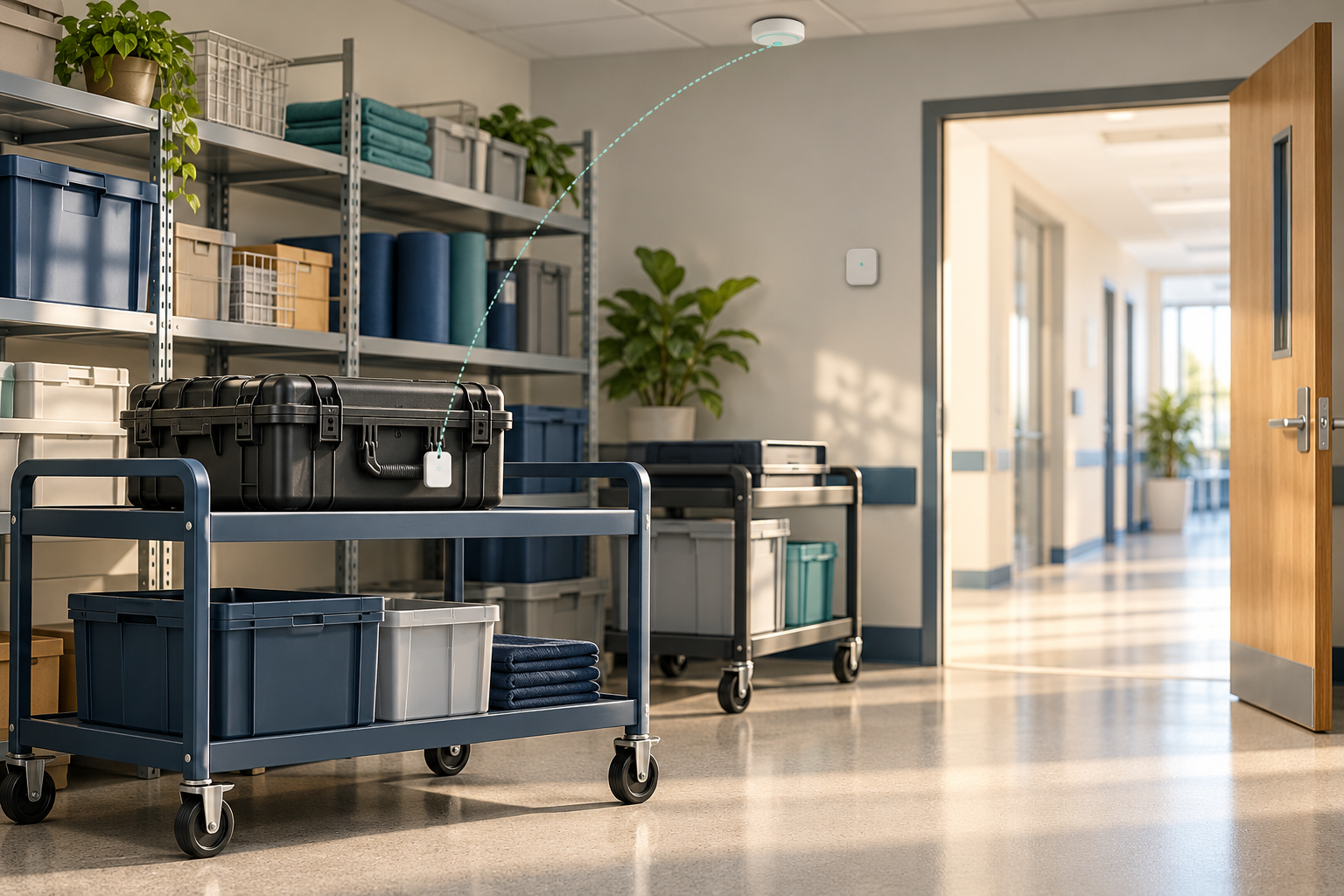
Begin with a facilities or equipment-store question: can an authorised team find a tagged utility asset, or investigate a defined room-condition exception? Keep those observations separate. Neither a location dot nor an environmental reading establishes that equipment is ready for clinical use.
Choose the record the operating team actually needs
Asset identity and location
Link the physical tag to a verified asset record and an agreed zone or location definition. Keep last observed, currently observed and unknown distinct. Finding a tag is not proof that the correct equipment is present or ready.
A separate environment record
Define the physical variable, units, observation point, suitable reference method and facility-approved review rule. A room observation does not establish the condition of an item inside a case, refrigerator or other enclosure.
A responsible operational action
Name the equipment custodian or facility reviewer, allowed action and fallback. Keep the existing readiness, maintenance and service records authoritative. Exclude patient monitoring, diagnosis, treatment and employee-performance inference from this pilot.
Connect an observation to a recorded operational response
1 · Bound the asset or facility question
Choose a manageable non-clinical asset group or facility zone. Record the current search/inspection process, required location granularity or environmental variable, responsible team and what would count as useful evidence.
2 · Verify identity and deployment fit
Check asset-to-tag mapping, approved attachment, location/zone names and a reference inventory. For an environment route, identify sensor placement, reference instrument and relevant operating range. Responsible site owners approve installation and maintenance arrangements.
3 · Check representative conditions
For location, compare known positions and ordinary movement through doors, storage and different floors. For environment, compare observations against the agreed reference under representative conditions. Retain errors, missed observations, delay and coverage limits rather than relying on a best-case headline.
4 · Preserve time and quality
Keep observation time, receipt time, identity, configuration and quality state with each record. Mark stale, offline, unobserved and disputed mappings explicitly. Do not infer equipment availability, room suitability or a safe condition from missing data.
5 · Investigate and record the response
An authorised operator checks the physical asset or facility condition using the existing approved procedure, records the finding and takes an allowed action. Any readiness or maintenance status comes from its own responsible process, not from proximity or location alone.
6 · Maintain and reassess usefulness
Record tag changes, moves, batteries, calibration/reference checks, layout changes, access and software revisions. Recheck representative conditions after material changes. Expand only when the team can use the evidence and maintain a workable manual fallback.
Define a location acceptance record
Agree room/zone identity, known reference positions, movement routes and test windows. Report wrong-zone or wrong-floor observations, detection availability, delay and stale intervals. NIST's localisation guidance separates test methods from application-specific performance requirements; this pilot sets no universal metre-level threshold.
Define an environment acceptance record
Specify the measured variable, units, placement, reference instrument and comparison procedure. Keep sensor error and response delay separate from radio delivery. The facility owner supplies any operational threshold and escalation rule; this publication gives no clinical, medicine-storage or sterility limits.
Keep location separate from readiness
An asset can be located yet unavailable, damaged, due for maintenance or assigned elsewhere. Preserve the independent status owner and the authorised physical check. A tracking dashboard must not silently replace the equipment-management record.
Limit access and secondary uses
Review collected fields, location granularity, account permissions, exports, retention and joins to other systems before collecting data. Equipment movement can reveal staff or patient-related patterns when linked elsewhere. Do not include identifiable personal records in the pilot brief.
Make the data route and maintenance observable
Specify tag/sensor, receiver or locator, network, platform and receiving work queue. Agree device identity, configuration ownership, access, update and recovery responsibilities. A named protocol or cloud product does not prove a working installed workflow.
Measure operational usefulness without inventing benefit
Use a comparable baseline for search/inspection effort, context-complete responses, unresolved exceptions, missing/damaged tags and actual maintenance cost. Any patient benefit, compliance, loss reduction or financial saving requires separate suitable evidence. None is reported here.
Prepare a requirements brief
Describe the non-clinical asset group or facility zone, operating question, current search/inspection process, desired record, existing systems and responsible team. State explicitly whether the first scope is location or an environmental observation. Prepare a private requirements enquiry for Admin review. Keep credentials, private personal records and security-sensitive drawings out of the initial brief. Onward sharing is optional.
Sources and applicability
NIST's introduction to ISO/IEC 18305 and its 2024 testing-challenges page support representative, site-specific localisation evaluation; they do not certify a product or supply this pilot's acceptance thresholds. The NIST IR 8259A overview supplies device-capability planning context. The workflow, environment checks and operating boundaries above are original editorial guidance to adapt with responsible site owners.
NIST introduction to localisation test and evaluation
NIST challenges of testing indoor localisation systems
Continue the operational evaluation
PROVIDER OPTION
Quuppa — non-clinical asset-location route
Investigate tags, locators, compatible software and a demonstrated equipment workflow.
PROVIDER OPTION
Vaisala RFL100 — facility-environment route
Investigate the probe, compatible radio/access point, monitoring route and response evidence.
INDUSTRY
Healthcare operations
Keep facilities and equipment operations separate from clinical claims.
PRIVATE ENQUIRY
Prepare a private requirements enquiry
Describe the operational question and evidence gap for private Admin review.