
CONNECTED TECHNOLOGY. CLEARLY EXPLAINED.
Networks & Connectivity
Choose connected-device networks by range, power, traffic, topology and verified interoperability for the required function.
Connectivity choices sit at different layers. A radio, network and application protocol answer different questions; a shared label alone does not establish that two devices implement the same function.
Choose the data path
Local networks
Measure coverage and interference where devices will actually operate.
Wide-area connections
Account for coverage, provisioning, upload intervals and recurring service cost.
Application protocols
Verify data models, authentication and supported roles on both ends.
Explore the network and application layers
Home and local wireless
Choose the actual device function, communication path and power context before comparing radio labels. Check network roles, provisioning, supported application features and performance in the intended locations; a shared wireless logo does not establish a complete working system.
Wi-Fi · Bluetooth LE · Bluetooth Mesh · Thread · Zigbee · Z-Wave · UWB · NFC.
Cellular and wide area
Start with the workload, operating region and required delivery timing. Review operator coverage, device provisioning, service plans, roaming and recovery, including the cost and support implications of a deployed fleet.
LTE-M · NB-IoT · 4G · 5G · Private cellular networks · eSIM · iSIM · Satellite IoT.
LPWAN and long range
Map devices, gateways, network services and application responsibilities separately. Assess message size, timing, regional requirements, access and maintenance in the actual deployment; a long-range radio claim does not establish usable end-to-end coverage.
LoRaWAN · LoRa radios · LPWAN gateways · Low power mesh · Sub-GHz radios · Long range telemetry.
Wired and industrial networks
Distinguish physical interfaces, network transport and application semantics. Have the responsible integrator verify topology, addressing, supported roles, timing and operational boundaries for the installed equipment.
Ethernet · RS-485 · CAN bus · Modbus · Industrial Ethernet · Powerline · Fieldbus.
Interoperability and application protocols
Check what each endpoint can actually describe and do, how identities and permissions are handled, and which versions and features match. Transporting a message is different from interpreting it correctly or successfully completing an action.
Matter · MQTT · CoAP · HTTP APIs · WebSockets · OPC UA · DDS · Device discovery.
Network equipment and operations
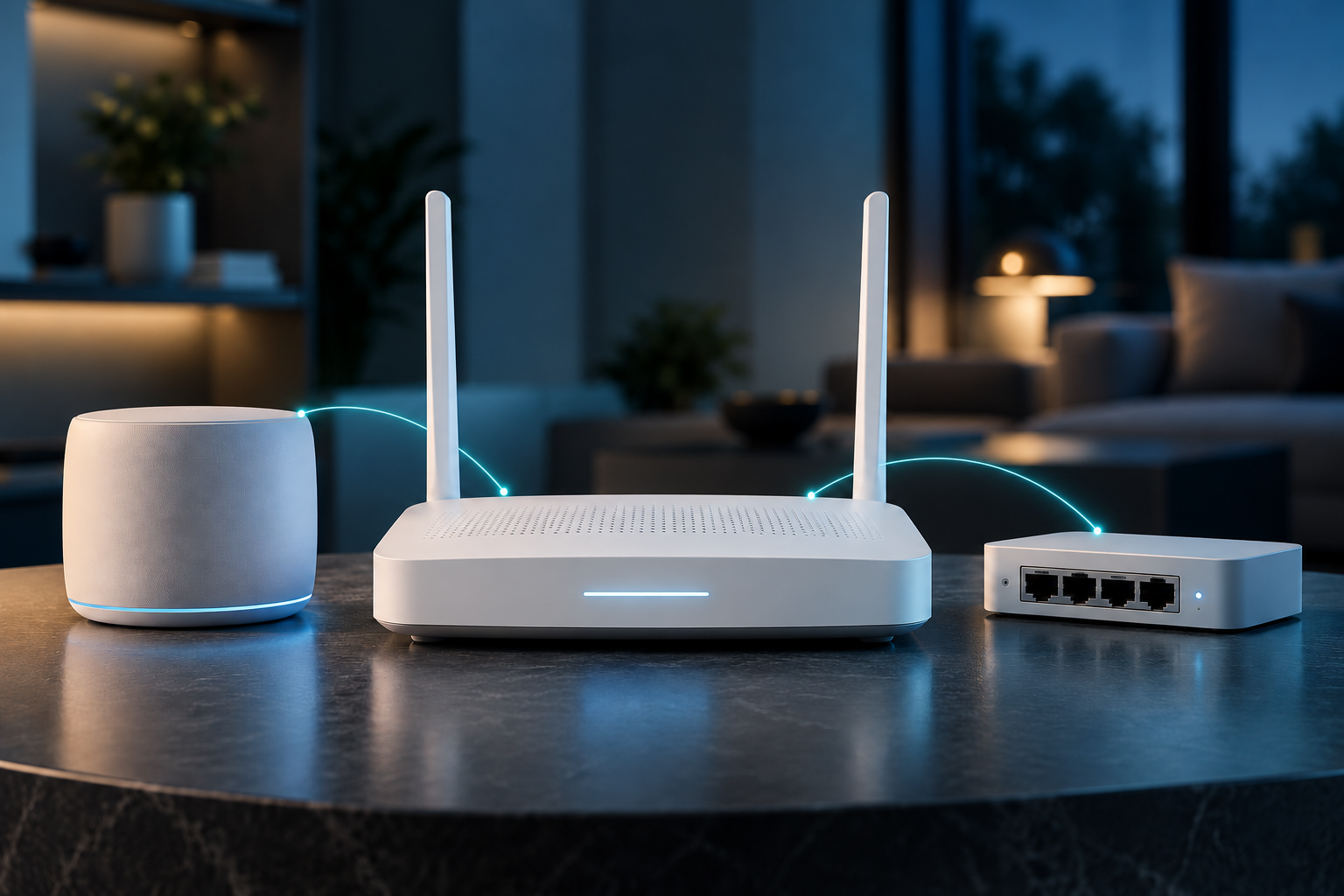
Keep an inventory of routers, access points, switches and gateways with their owners, configuration, updates and recovery method. Make stale data, disconnection and restoration visible to the application rather than reporting only whether a device is currently online.
Routers · Access points · Managed switches · IoT gateways · Network monitoring · Network planning · Spectrum testing.
A practical example
For a room sensor, trace sensor to gateway, controller and application. Record the path for an ordinary reading and for an alert. Repeat after loss and restoration of connectivity, checking whether old readings can be mistaken for current data.
Questions to resolve
- What data rate and delay does the application actually need?
- Which component bridges between networks or ecosystems?
- How are discovery, identity and reconnection handled?
Use the evidence
The category map describes technologies and product types. It does not establish that a particular model is available, tested or compatible. Check the exact model, region, documentation and support arrangements before buying.
Work through the connected-technology buying checklist
Protocol reference
Connectivity Standards Alliance: Matter FAQ. Check device and controller roles in the product documentation.
Network roles and topology sources
Thread Group: Matter and Thread FAQ explains the distinction between network connectivity and application functions. Bluetooth SIG: topology options supplies context for different communication arrangements. Evaluate the documented device roles and the actual data path; neither reference is a site survey, product-compatibility test or guarantee of range.
Evidence: Category guide. Reviewed 2026-10-18. By Admin.
Implementation, wireless roles and wider networks

CONNECTIVITY & SERVICES
When does hybrid cellular and satellite IoT make sense?
Use a second path when it supports a specific operating need. Design message identity, path selection, outage behavior and recovery before calling a system resilient.
CONNECTIVITY & SERVICES
Telecom Operators & IoT Services
Understand the networks, SIMs, managed services and operating choices behind connected devices. Find the right questions for a pilot, a provider and a long-term service.
CONNECTIVITY & SERVICES
Satellite & Space IoT
Explore remote-device messaging, satellite backhaul and hybrid networks. Keep communications, positioning and Earth-observation data distinct, then check the service your application actually needs.
RELATED READING
IoT implementation: connectivity, scale and maintainability
Follow connectivity into provisioning, recovery and maintainability.

EXPLORE FURTHER
Thread: network roles and border routers
Review Thread connectivity separately from Matter application functions.
RELATED READING
5G and IoT: match the network to the workload
Match cellular capabilities to the actual workload and operating context.
RELATED READING
IoT in space: communication when the link is interrupted
Understand delayed delivery, buffering and interrupted links.